
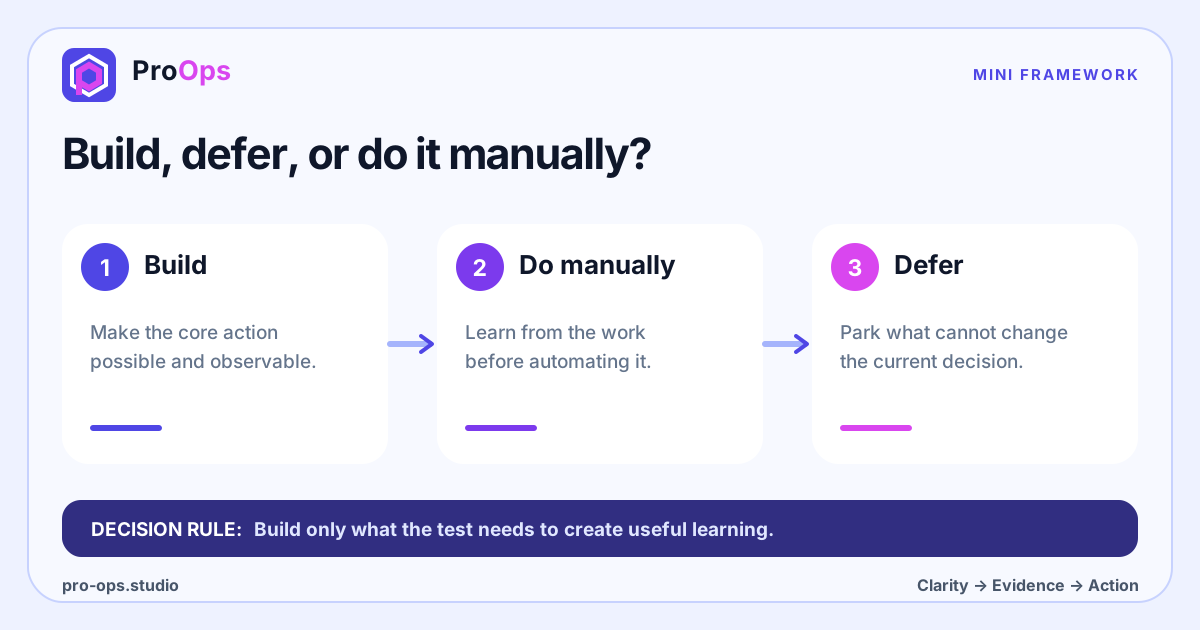
Founders often debate features as if the only choices are build or abandon. There is a third option: handle a step manually while you learn whether it matters.
Build what the test cannot work without
Build a feature now when the user cannot complete the core action without it, or when the feature is needed to observe the behavior you are testing. State the reason in one sentence. “Competitors have it” is not enough.
For example, if you are testing whether a team will use a shared approval flow, the approval step is central. An advanced dashboard may be irrelevant to the first decision.
Do repeated but uncertain work manually
Manual delivery can be a good early choice when the process is small, the user experience remains dependable, and you learn from each interaction. Tell users what to expect. Track how much time the work takes, because a manual step can become the next bottleneck if demand appears.
Do not use “manual” as cover for an unreliable promise. If the task requires speed or accuracy you cannot maintain, reduce the pilot size or fix the process first.
Defer anything that cannot change this decision
Put an item in the defer list when the current test would produce the same learning without it. Record what new evidence would move it into the build list. That turns a parking lot into a decision rule.
The MVP Scope-Down Worksheet helps you separate core action, manual support, and deferred work. Revisit the list after observing real use—not after another internal brainstorming session.