
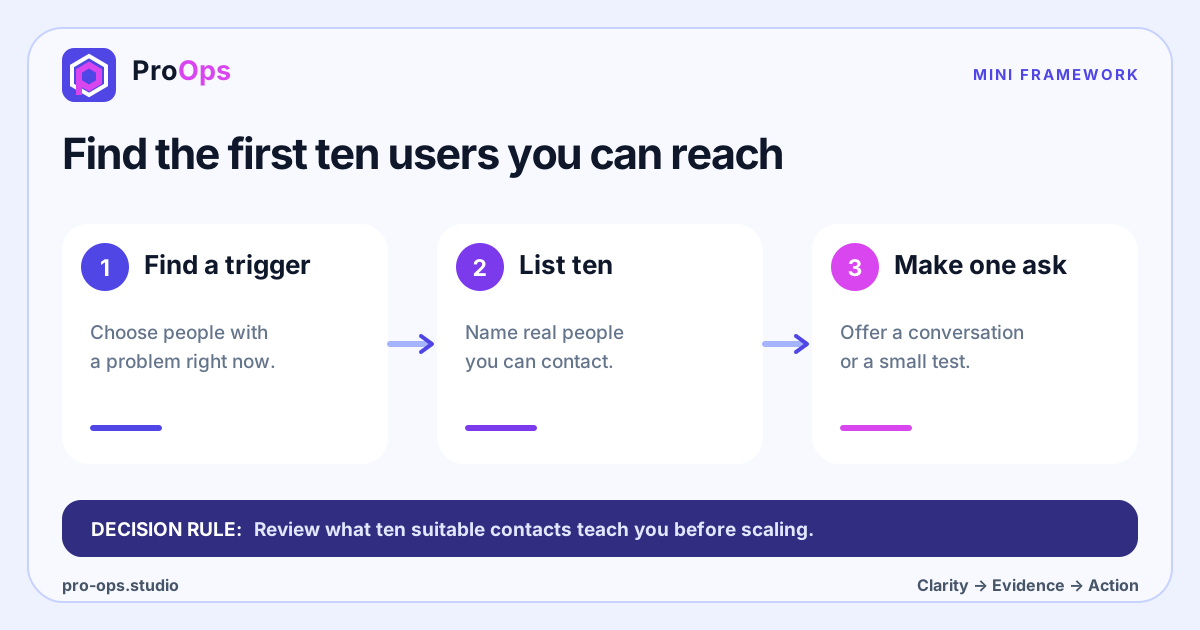
“Our market is millions of people” does not tell you whom to contact on Monday. First-user work begins with a smaller question: who has the problem now, and how can you reach them without pretending you have a full growth engine?
Use the trigger, not a demographic label
Describe the situation that makes the problem urgent. “Small companies” is broad. “Operations leads who just added a second delivery team and now reconcile two schedules by hand” gives you a reason to start a conversation.
List ten real people or organizations that fit the trigger. If you cannot name ten, you may need to narrow a different way or learn more about where the work happens.
Check the current alternative
For each prospect, ask what they do today. Their current workaround is your competition. It may be a spreadsheet, an assistant, an agency, or the decision to do nothing. Your first offer needs to make a specific part of that workflow better enough to try.
Make one ask
Invite each person to a concrete next step: a brief problem conversation, a small pilot, or an attempt at the core task. Avoid a long pitch. Track who replied, who took the action, and why others declined.
After ten suitable contacts, review the pattern. If no one recognizes the problem, revisit the trigger or offer before increasing outreach volume. The Pilot Design Checklist helps you turn any real interest into a test with clear participation and learning.