
Early outreach is not only a way to fill a pipeline. It is a test of whether the customer, timing, and offer make sense together. A low reply rate can be useful evidence if you know what you tested.
Start with one customer and one situation
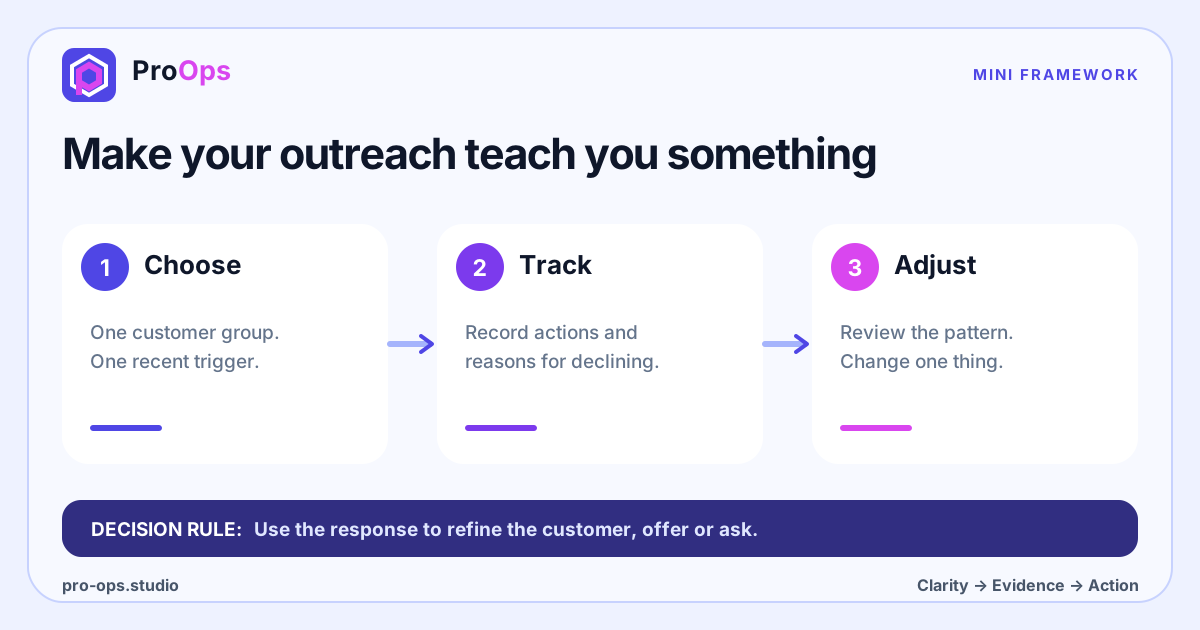
Choose a narrow group and a recent trigger. Write a message that shows you understand the work they are doing today. Do not lead with a list of product features or a generic promise to “save time.”
A useful message states the situation, the result you can help create, and one small ask. Make it easy to say no. That gives you a clearer read than a long pitch that asks the person to decode your offer.
Track more than replies
Record the source, message version, relevant trigger, reply, next action, and reason for declining. A polite answer is not the same as a pilot commitment. If people respond but never take the next step, inspect the offer or the effort you ask of them.
When someone objects, ask what they currently use and why changing would be hard. Those answers often reveal the real competitor and the support a first pilot would need.
Review the pattern, then change one thing
After a small batch, compare results. If the target group does not recognize the problem, change the customer or trigger. If they recognize it but do not want the pilot, change the offer or ask. If they join but do not use it, inspect the experience.
The Pilot Design Checklist helps you turn a promising outreach conversation into a bounded test instead of an open-ended favor.